

Frozen Warnings
A 5,000-year-old bacterium shows how unprepared the world remains for the next health crisis.

A microbe trapped in ice for millennia has survived modern medicine. Its discovery exposes not scientific wonder, but political failure.
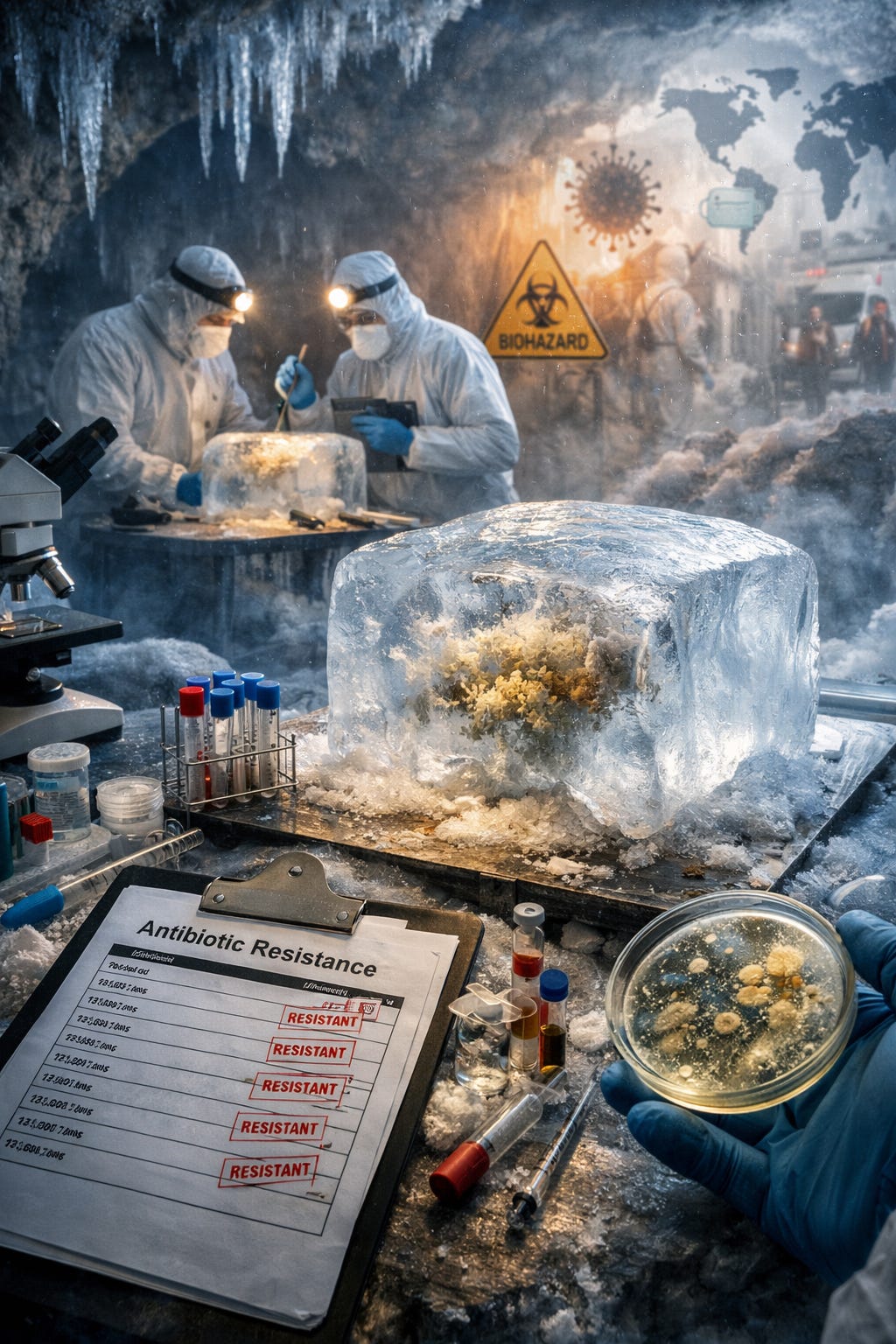
The discovery of a 5,000-year-old bacterium in a Romanian ice cave sounds like a story from a science magazine. Researchers found that the strain, Psychrobacter SC65A.3, can resist many modern antibiotics. The findings, reported in Frontiers in Microbiology, were first detailed in a press release by EurekAlert and later covered by Science Focus, Popular Science, and Phys.org. Most reports treated it as a scientific curiosity. Few asked the harder question. What does this discovery say about how ready we are for future biological threats.

The bacterium was found in ice from Romania’s Scărișoara Cave. It was isolated from a 25-meter ice core taken from the Great Hall section of the cave, representing a 13,000-year climate record, as reported by Phys.org. The bacteria came from layers formed around five thousand years ago. When scientists revived it, they discovered it resisted 10 out of 28 tested antibiotics from ten major drug classes, according to EurekAlert. It carried more than 100 resistance-related genes, as documented by Popular Science. It could even inhibit some so-called superbugs, a finding highlighted by Phys.org. Dr Cristina Purcarea and her team warned that melting ice could release such microbes into modern ecosystems, as quoted by EurekAlert. They also noted that these organisms may hold clues for new medicines, including 11 genes with antimicrobial potential, reported by Phys.org. This dual message of risk and promise was repeated across media reports. Yet the larger political and social context was missing. Science alone does not protect societies. Systems do.


The study proves one uncomfortable fact. Antibiotic resistance did not begin with careless doctors or careless patients. It existed long before modern medicine, as explained by Dr Purcarea in EurekAlert. But human behavior has turned a natural process into a crisis. In many countries, antibiotics are sold without prescriptions. Patients stop treatment halfway. Doctors overprescribe to avoid complaints. Pharmaceutical companies focus on profitable drugs, not new antibiotics. Hospitals lack infection control. The Romanian bacterium is not the main danger. Our misuse of medicine is.
The COVID-19 pandemic should have been a turning point. It exposed weak surveillance, slow decision-making, and political interference in health policy. In Pakistan and many other developing states, hospitals ran out of oxygen. Health workers protested for protective gear. Fake medicines flooded markets. Data was often unclear or manipulated. Lockdowns were delayed for political reasons. Religious and political gatherings continued. Leaders held press conferences instead of building systems. When vaccines arrived, inequality shaped access. Some learned lessons. Most returned to old habits.
Today, governments claim they are better prepared. They point to emergency units, task forces, and glossy policy documents. These measures look impressive in presentations. On the ground, reality is different. Many laboratories still lack equipment. Disease reporting remains slow. Rural outbreaks go unnoticed. Drug regulators are underfunded and pressured. Hospitals depend on temporary funding. Staff leave for better jobs abroad. Preparedness is not about announcements. It is about boring, expensive, long-term work. Few politicians have patience for that.
The Romanian discovery matters because climate change is reshaping disease risks. As glaciers melt and permafrost thaws, long-frozen microbes may re-enter ecosystems. Global travel can move pathogens across continents in hours. Urban crowding speeds transmission. Weak sanitation spreads infection. In this context, antibiotic resistance becomes more deadly. Common infections become harder to treat. Surgery becomes riskier. Cancer therapy weakens immunity. Childbirth becomes dangerous again. These are not distant fears. Hospitals in South Asia and Africa already struggle with drug-resistant infections, a crisis linked to 1.27 million deaths in 2019, according to figures cited by Popular Science.
Researchers such as Dr Purcarea stress careful laboratory handling. They warn against accidental release of resistance genes, as reported by EurekAlert. These warnings are important. But laboratories are only one part of the picture. The greater risk lies in unregulated markets, informal clinics, and poorly managed hospitals. In many countries, inspectors rarely visit pharmacies. Fake drugs circulate openly. Online sellers operate freely. Patients self-medicate. This is where resistance spreads daily, not in sealed research facilities.
There is also a political economy behind this neglect. Prevention brings no applause. Stockpiles, surveillance systems, and staff training do not win elections. Crises do. Leaders prefer to respond dramatically after disaster strikes. They announce relief packages. They appear on television. They blame past governments. When the emergency fades, funding dries up. Reports gather dust. The cycle repeats. COVID followed this pattern. Future outbreaks will too, unless incentives change.
The Romanian bacterium also reveals another failure. Global cooperation remains fragile. During COVID, wealthy countries hoarded vaccines. Poor nations waited. Travel bans were imposed without coordination. Information was politicised. The same dynamics will shape future health threats. Antibiotic resistance does not respect borders. Yet funding for global surveillance remains limited. Research depends on short-term grants. Low-income countries are treated as data sources, not equal partners.

Some policymakers argue that technology will save us. They speak of artificial intelligence, genomic tracking, and rapid diagnostics. These tools matter. But technology without governance is useless. A fast test does not help if hospitals are full. A genome sequence does not matter if drugs are unavailable. An early warning system fails if leaders ignore it. COVID showed this clearly. Data existed. Action lagged.
A serious response would look different. Governments would regulate antibiotic sales strictly. They would invest in public laboratories. They would protect health whistleblowers. They would publish transparent data. They would fund research on neglected diseases. They would cooperate across borders. They would treat health security as national security. Most do not. Budgets tell the truth. Defence and infrastructure dominate. Public health remains marginal.
The Romanian discovery should not be reduced to a headline about ancient microbes. It should be read as a warning. Nature has always been adaptive. Bacteria evolve. Viruses mutate. Humans are the fragile part of the system. Our institutions are slow. Our politics is short-term. Our markets reward neglect. Until these structures change, every new pathogen is a gamble.
The frozen bacterium survived five thousand years in ice. Our health systems struggle to survive five years of crisis. That is the real story. It is not about a cave in Romania. It is about a world that keeps learning the same lesson and keeps refusing to act.
This article should worry every reader in countries like Pakistan, Bangladesh, Nigeria, and much of Africa and South Asia. If a bacterium frozen for five thousand years can already defeat modern medicine, what chance do weak health systems have when the next crisis arrives?
In Pakistan, antibiotics are sold like candy. No prescription. No guidance. No records. People stop treatment when they feel better. Fake medicines circulate openly. Clinics operate without oversight. Hospitals lack basic infection control. In such an environment, drug-resistant bacteria do not need ice caves to survive. They are already among us.
COVID exposed this reality. We ran out of oxygen. Doctors worked without protection. Data was hidden or delayed. Politics shaped health decisions. When the emergency passed, nothing truly changed. The same broken systems remain. The same neglect continues.
If a serious outbreak of antibiotic-resistant disease spreads tomorrow, it will not be stopped by press conferences or slogans. It will spread through crowded cities, poor sanitation, weak labs, and unregulated pharmacies. The poor will suffer first. Then everyone else.
This Romanian discovery is not distant science. It is a warning. Countries like Pakistan are standing on thin ice. Without investment in public health, regulation, and transparency, the next crisis will not be a surprise. It will be a consequence of our own refusal to prepare.